Circles 2.0: Color

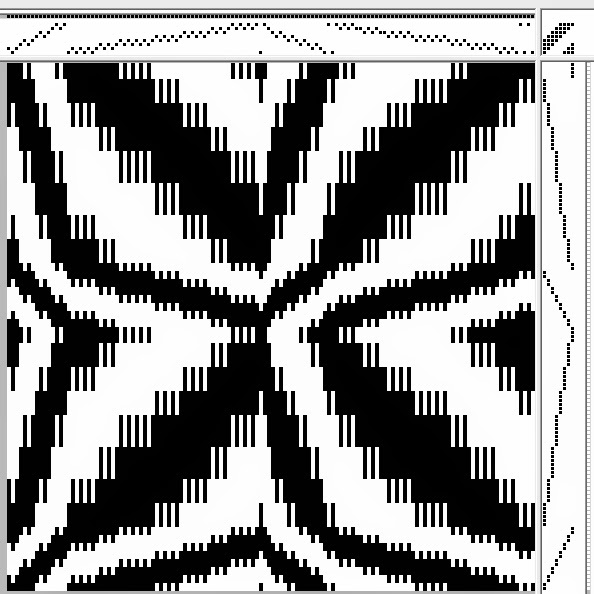
So this Turned Taquete Circles draft is enjoying some further refinement, thanks to another blog reader. The tie-up that Peg provided (see previous post) had some four-thread floats, which were not hugely problematic. In fact, Peg is weaving scarfs using that tie-up as I write! But with that tie-up color order in warp and weft became touchy, and could emphasize those floats in at least one scenario. Thus, LaJean worked with the tie-up some more and came up with a draft with the longest floats being only three threads.
Well done! Here is LaJean’s version:
Readers who request the wif for this design will now get the new and improved version. If you have Peg’s version, no worries, just adjust the tie-up a bit and we’re all good.
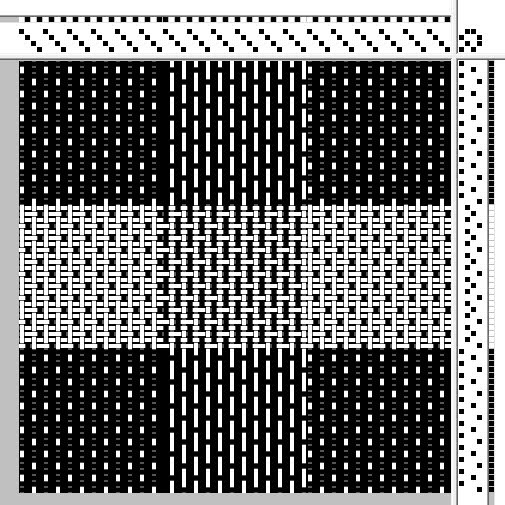
Now, the following is a short demonstration how color order in Turned Taquete can make a difference. The first graphic is all structure and no color. White warp and white weft. You might be able to see the circles if you have the eyes of an eagle, but you probably don’t.
This second graphic reveals the circles by the addition of a light gray alternating with white in the warp. White weft. Very subtle.
Now changing out light gray for black in the warp really shows those circles. You could weave a scarf alternating a light neutral and a darker handpainted warp, with the same neutral in the weft.


This graphic shows the difference changing the warp color order makes. Instead of white/black, we have black/white.

This has the same warp color order, but changing the weft to black. Very dramatic.


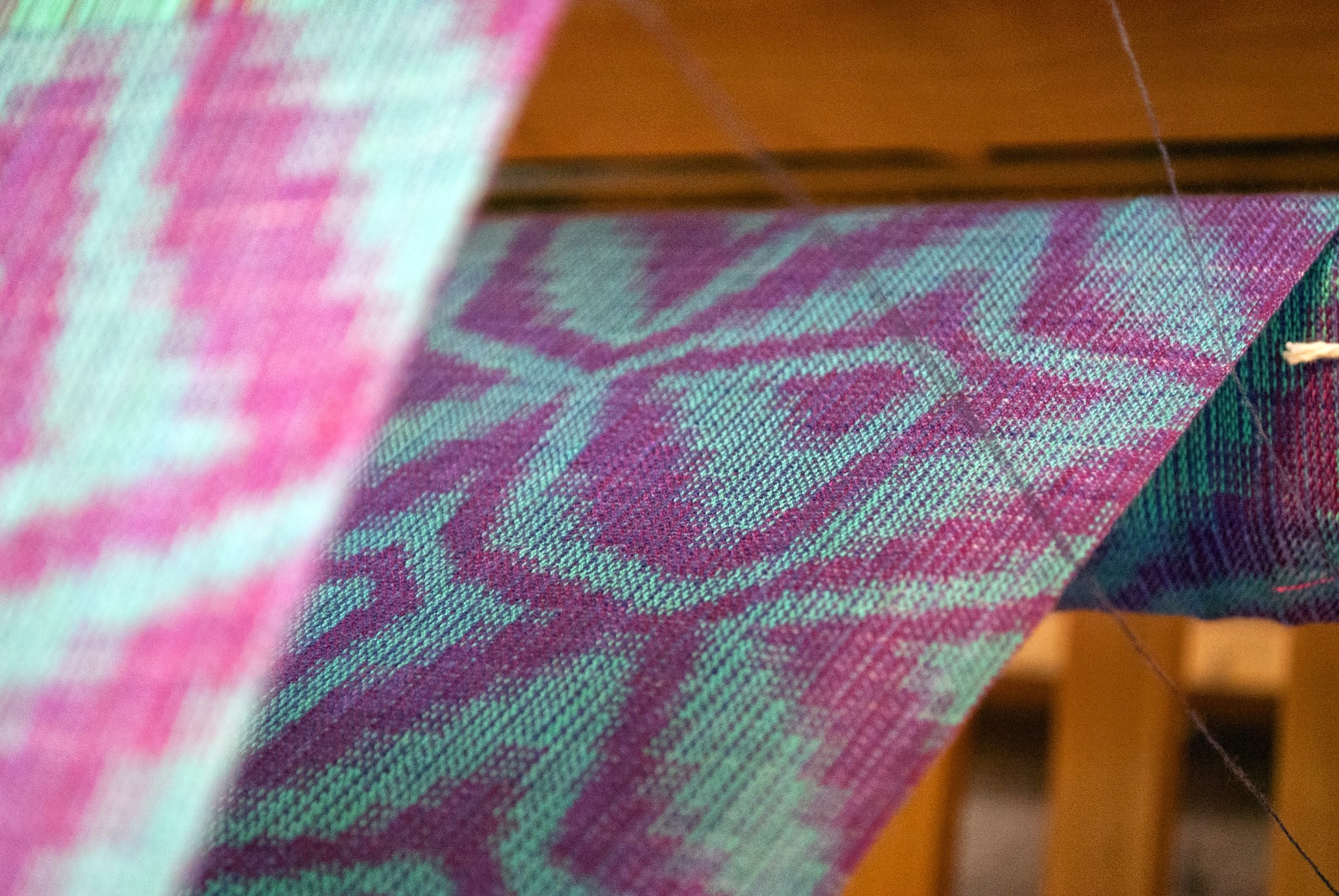
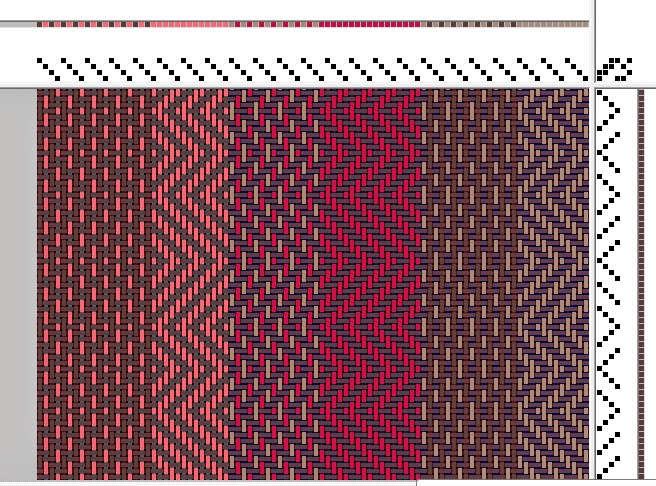
Now, add color. Suddenly, the variations are infinite. The Fiberworks program has a nifty tool that lets you substitute colors pretty quickly, so if you don’t like one combination, there are many more to try.


Peg recommends shortening the treadling sequence on treadle 7 so that the circles will be more round. That was a freebie! 😉


Around and Around in Circles

I like things with circles. This is vase is a case in point, and it had me at the dots. (The rest of it is pretty good, too. Unknown student artist from Iowa State University, c. 2003.) And don't get me started about stripes!

This scarf, found in a tiny store in Paris, is another example. I blogged the story of it here. I loved all the variations of circles in a woven fabric. I just had to bring it home with me.

I have an on again, off again obsession with weaving circles, made all the more of an obsession by the fact of my limitation of 8 harnesses. If I had 32, 24, or even 16 harnesses, the difficulty in designing for circles would be much less. But for now, I only have the one loom, and I am stuck. I designed a scarf in Diversified Plain Weave for Handwoven Magazine, May/June 2013. And it started from this graphic:

That graphic became this profile draft:

And then it beame this color profile draft:

And then it became this scarf on the loom:

At the time I played with complicating the design by moving the circles into two repeating offset rows. To get to that, the profile draft increased to 8 blocks. Unfortunately, there's not a lot of weave structures that I could substitute into that profile draft that would make an interesting, clean rendering of it, given my 8 harness limitation. Crackle Weave came close, but no cigar. I wanted to try Turned Taquete, and I gave it the old college try, but I soon realized that the way these circles are positioned was not working for me.

,
So I tried positioning the circles farther apart. This is the profile draft Ifinally came up with. The cirlces are four blocks each, and I had to tweek the tie-up until I got it to work.
Since moving, I have upgraded my computer and software considerably. I purchased a Macbook Pro and installed Fiberworks PCW (new to me) and upgraded my Pixeloom. So now I have dueling weaving software and they don't do everything equally. I tried echo theadings on both programs, and I was much more satisfied with the result from Pixeloom. Just sayin'.
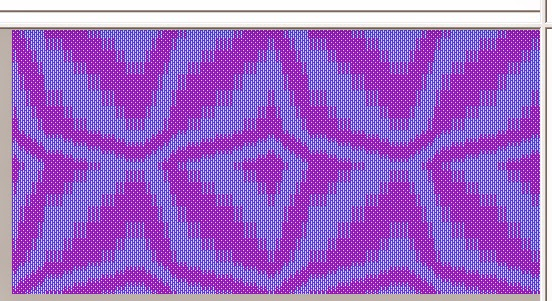
Here is the final Turned Taquete Circles drawdown. It took a LOT of trial and error and tweeking, but I finally did it. So what shall I weave?


Turned Taquete: Next Generation

Over the years I've had several projects published, mostly by Interweave Press. My earliest project was in 1984 when I had two dishtowels accepted for the Design Collection series. I was soon to start an MA program in Craft Design at Iowa State University and I was beyond excited! The next two were a woolen scarf for another Design Collection and, sometime in the 90's, a necktie with palm trees in Theo Moorman technique that was actually in a Handwoven magazine. (BTW, all of my magazines and books are in storage right now so I can't actually check dates or anything.)

After a huge block of time, decades, I was invited to submit a project for a scarf in Diversified Plain Weave to Handwoven and wrote about it here. The project was a 6-block houndstooth pattern woven using Diversified Plain Weave (DPW for short) for the structure. The next year I submitted another DPW project for Handwoven's color themed issue, this time the concept being woven circles (a neat trick using only 6 blocks I might add).

This attention is fun, but in the back of my mind, I always wonder who (if anyone) ever actually weaves these projects. Okay, show of hands: how many of you have actually woven the Circles Scarf????

Well.

Fast forward to … 2015. I wrote in this blog about a Turned Taquete scarf that I designed from a pattern called Jitterbug.

It was my first attempt at using the book Weaving with Echo and Iris. That design was both fun and very challenging. I was so happy when I finally got it right and wove it and shared it in this blog.

And it didn't go unnoticed! Denise Kovnat, who is in the Rochester, NY area, and writes the blog Random Acts of Color, asked my permission for one of her students to use my design in a workshop she taught at MAFA in Pennsylvania. Of course I said yes! And then recently she sent me an image of the finished piece that her student wove. And. Oh. My. God. Take a look at this:


This scarf was woven by Tina Kiethas and it won an award! Says Tina: “The scarf was in the Philadelphia Guild of Handweavers “Celebration of Fibers” show, and it won the Katherine Wellman Memorial Award for imaginative weaving incorporating design, color, and texture.” She hopes her piece will inspire others to try Turned Taquete.

I am so happy for Tina, and so proud that she used my design for her weaving. Well done!


Stashbuster Turned Taquete Towels

I am slowly cleaning out my studio, going through my yarn, some of which has been on the shelves for literally more than a decade. We plan to pull up stakes next year and move to be near the grandchildren (yay!), and moving every last little cone of yarn doesn’t really make sense. To that end, I decided to finish up all the mini-cones of 10/2 cotton that I bought in the 90’s in a Turned Taquete Dishtowel warp. I supplemented judiciously with newer 10/2 cotton that I bought last year, but I did it! I can cross one more thing off my inventory list.

I designed a very simple Turned Taquete warp:

This is my standard straight draw threading. I alternated dark/light threads for the first block, then alternated light/dark for the next. The third block is back to dark/light. You can do that as many times as you want to get the width that you want. For the treadling, I go 1314 with a color, then I might switch to 2324 for another color, but you don’t have to. You could treadle 1314 for the whole towel, and just change colors without changing the treadling at all. Easy peasy.

For blogging purposes I took some informal iPad photos of the towels before they are cut apart and wet finished.
This is Destash Towel #1:

On all of these I was aiming for 1″ checks, but I wove them 1 1/4″ or so to allow for shrinkage. I had six colors on bobbins in a rotation that I repeated 4 times. My notes are bad on this one, but I think I alternated 1314, then 2324.

This is Destash Towel #2:

For this one I again used six colors in rotation. I wove each color on 1314, then 2324. I still ended up with 24 checks, but this time I would have 2 repeats of the rotation.

This is Destash Towel #3:

This one was more complicated, using 5 colors in rotation, but alternating them like this:

[color] a on 1314, [color] b on 2324, [color] a on 1314, [color] b on 2324

[color] c on 2324, [color] b on 1314, [color] c on 2324, [color] b on 1314

[color] c on 1314, [color] d on 2324, [color] c on 1314, [color] d on 2324

[color] e on 2324, [color] d on 1314, [color] e on 2324, [color] d on 1314

[color] e on 1314, [color] a on 2324, [color] e on 1314, [color] a on 2324

[color] b on 2324, [color] a on 1314, [color] b on 2324, [color] a on 1314

I was starting to do anything to keep the interest up….

This is Destash Towel #4:

Desperate to finish at this point. I just treadled 1314 for the whole towel, using 6 colors in rotation, repeated 4 times.

Destash Towel #5:

Oops, I had enough warp to weave another half of a towel, and save it for myself. It’s kind of a tradition now.

I treadled 2324 with just one color, going for the stripes.

Now I am moving on to all those odds and ends of 6 ply rayon for a stashbuster rayon scarf…


Jitterbug and Turned Taquete: Step By Step

I’ve always been intrigued with this design.

I found it in the book A Handweaver’s Source Book: A Selection of 146 Patterns from the Laura M. Allen Collection, edited by Marguerite Porter Davison. It is the first pattern in the book, appearing on page 12. This pattern collection differs from most in that the draft is given in a shortened version and it is assumed that the weaver will be able to derive a useable draft from the information given. Certain conventions apply: a standard twill tie-up and tromp as writ treadling.

Meanwhile, I have been studying Marian Stubenitsky’s Weaving with Echo and Iris. I love the designs in this book, and I wanted to weave them, but I also wanted to understand how to take a profile draft all the way to a Turned Taquete draft. Not easy. Not intuitive. Also, when I try to get my head around network drafting, which Stubenitsky relies on a lot, my eyes roll up in my head, and I reach for a glass of wine.

In this post I will take you through the steps that (I hope) will get any weaver from a four harness pattern draft to an eight harness Turned Taquete fabric. (Disclaimer: I’ve only done the one design, so this process is only for the bravest of the brave. Expect setbacks. But persevere.)

First Step: Take the pattern and write it as a four block profile draft. Treadling is tromp as writ.

Second Step: Rewrite the four block draft as eight blocks. (You will need eight blocks to translate to eight shafts in order to interleave the threading.) Treadling is still tromp as writ.

Here is the eight-block threading, also known as the Design Line:

In her book, Stubenitsky devotes a huge amount of space to four-color threadings, but I was more interested in two-color threadings. I zeroed in on interleaved threadings that can be woven as Turned Taquete, see pages 195-199. Once the eight block Design Line is established, the next step in the book is to take the line and pair each end on a 1/1 network. Since I don’t do Network Drafting, I prefer to just say, Pair each end with its up or down partner without increasing the total number of ends. As I see it, this pairing of ends in the Design Line will create more of a flow in the design, easing the blockiness of it.

So this is the Third Step and this is what that draft looks like:

Notice that the tie-up is now 4/4 and the treadling is still tromp as writ. Here is the threading:

The next step is to interleave the paired threading at an interval of your choice. I decided on an interval of 4, but you could do 3. This is why we have weaving software. I went to Threading, Echo, and chose my interval, and then voila.

Fourth Step:

Now the number of warp ends has doubled, and has two alternating colors. Later I will change the black and gray to aqua and magenta. The weft will be lavender.
Fifth Step:
Adding tabby treadles to the tie-up (10 treadles are necessary here) and inserting tabby shots to the treadling draft. One repeat of the threading is 264 warp ends. One repeat of the treadling is 264 weft shots. I doubled the threading to 528 ends. One, because you really need to do that to get the full impact of the design, and two, because my warp was sett at 56 epi and I wanted more than four inches in width. Here is the treadling draft and tie-up:
This color draft shows the final result.
I was a bundle of nerves getting the warp on the loom and starting to weave. The warp is 20/2 tencel sett at 56 epi, and it took forever to thread the heddles. The tencel itself is a joy to work with and it wound on just fine. I wove a few inches and was so overjoyed that it actually worked that I forgot that I was weaving top to bottom instead of bottom to top. In addition, I am weaving the back as the front. Yikes!
I threaded the warp colors magenta/aqua instead of aqua/magenta. Turns out that makes a difference ; – )
A few photos:

I’m using 20/2 tencel as the weft, but I’ve been reading about projects with 30/2 tencel or 60/2 silk as weft. If I had used a finer weft, the pattern motif would weave with less length. I will wait and see what the final result looks like once off the loom and washed and pressed. That 30/2 tencel is kind of hard to find, and silk is really not in my budget.

I’ve got enough warp for a second scarf, and I will try a different color weft instead of lavender for that one. Meanwhile, back to the loom!

Theory and Practice and Weaving from Times Past


Ok, I am working on a dishtowel warp and this is just a quick follow-up post to my last post. That post was all about how my Turned Taquete threading (which is actually just a straight draw) could be tied up for twill treadlings.

I’ve got enough warp for four towels and this is number three. And looking pretty good. As I explained before, threading stripes of solid color in between the stripes of contrasting color will ensure that the twill will show well.

*************

Now, on a completely different subject, I have begun “scanning” my slides of weaving from times past. I finished my Masters Degree in Craft Design in 1987 and began weaving and exhibiting for a period of time after that. I took many slides of my work, and have just finally begun the process of sorting these slides, and reproducing them digitally.

My gizmo of choice is this:

The Lomography Smartphone Slide Scanner works with my iPhone to capture the slide images quickly and easily. While not the super quality of the slide scanners I used to work with in my former life as a Curator of Visual Resources, the images I am getting are good enough and sometimes even great. I edit them in Photoshop, and upload them to Flickr. Some blog readers may have already noticed them on the Cooliris Flickr Wall on the right. More are coming!

And I will talk more about these weavings in a future post. For now I will say that I did a ton of work in boundweave with Summer and Winter threadings. Inspired by Peter Collingwood’s book on rug weaving, I called it polychrome Summer and Winter on opposites. Now everyone calls it Taquete. (Who knew?)


Turned Taquete Twill Variation [or] The Weave That Keeps On Giving

I hope everyone had a good holiday and isn’t too tuckered out after all the festivities. On my to-do list for January: a blog post about my latest batch of Turned Taquete dish towels.


I decided on colors reminiscent of the desert, or clay pots (or something), so I called them Desert Sands. I did four, and I decided to try some variations with weft choice and tie-up/treadling. The results were suprisingly interesting and downright fun. The first two were like the one above. Changing colors and blocks in a sequence that I decided on beforehand, and I like those just fine.

But, I needed a change, so I decided to weave one towel using one color and treadling just one block. It wasn’t boring at all, and it was faster, since I wasn’t changing bobbins every inch or so. The result was the towel below. Suddenly, instead of checks, we’ve got stripes! And I do love me some stripes.

But the fun doesn’t stop there! I really geeked out on the fact that the towel stripes are completely reversible. Voila:
The edges were the only part of the color sequence that were a solid color. All the other threading blocks alternated either dark/light/dark/light or light/dark/light/dark. By treadling a single block with a single color, the alternate warp color, whether or dark or light, always stayed on the back. BTW, this happens with any of the towels that I weave, checked or not, but with the stripes my delight in the process went a little overboard.
I wove the last towel using the stripes idea with a different color weft, but with this one I decided to go out on a limb and try a completely different tie-up and treadling sequence. Because I could.
If you look closely at the edge of this towel on the right, you will see a zig-zag twill. That twill appears across the whole towel of course, but you only see it on the edge, because I threaded the edge with the sequence light/light/light/light (same/same/same/same). The middle stripes all aternate, so the twill is a bit more, umm, subtle.
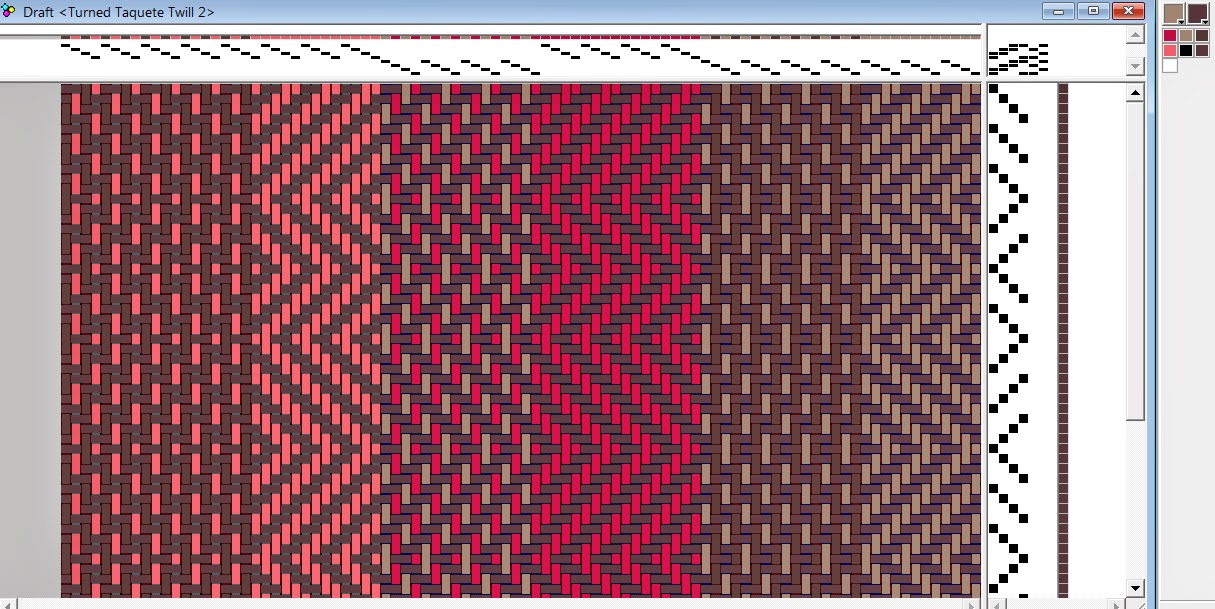
Keep in mind that this version of Turned Taquete is threaded on a straight draw. Never mind the color sequence. Straight draw means you can tie up for twills and you can treadle any twill sequence you want. (Light bulb going off in my head!) However. The twill only shows up in the stripes that do not alternate colors. Check it out. I blogged about this Turned Taquete design earlier:
By inserting non-alternating color stripes in the warp, I was able to create a step-ladder effect in the checks. Now look at it with a twill tie-up and a zig-zag twill treadling:
I know, right? (The black sripes are twill too, but they’re black/black so you won’t see it.)
Now, let’s look at roughly the same drawdown in color:

You can really see the zig-zag in the non-alternating color areas. The fact that this is a straight draw threading, while seemingly simple, just upped the potential number of variations on one warp by a ton!

For all the four-harness weavers, it doesn’t make a difference if you do this on four or eight harnesses. I do eight, but I like to utilize all the harnesses on my loom for any project. Saves the dreaded moving heddles chore. So here is the same design on four harnesses:

You’re welcome!


Stash Buster Gold

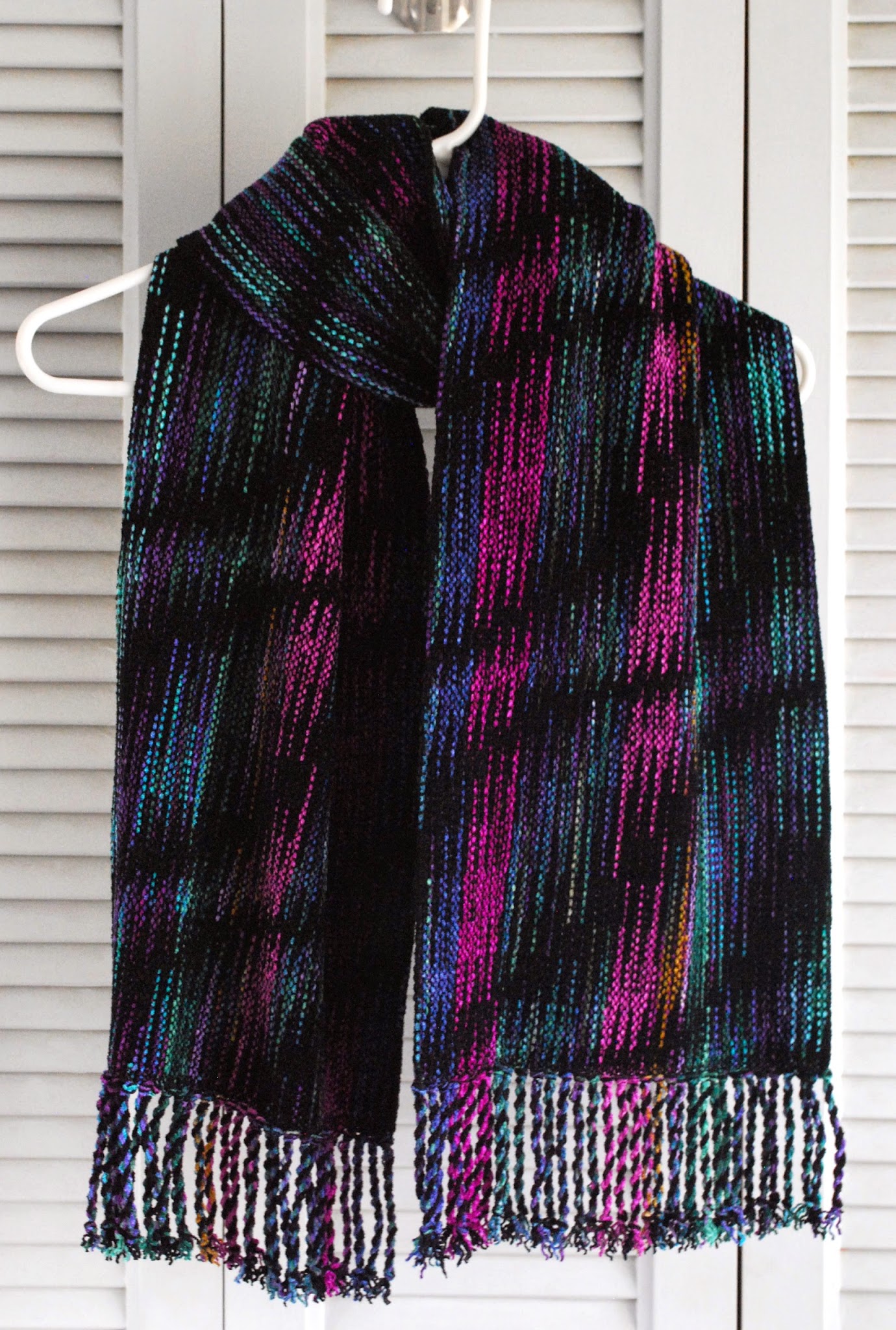
Here’s a stash buster rayon chenille scarf hot off the loom that has me totally in awe.

I wanted to try the interleaved, echo threading technique that has everyone buzzing. I wanted to use that threading with a Turned Taquete tie-up and treadling sequence. Plus, I wanted to try all that without taking the time to work out my own design. Lazy? Maybe, but I wanted instant gratification.

This is the result, a dramatic, luxurious scarf that had me before the end of the first repeat.

I used odds and ends and bits and pieces of the last of my 2000 yards per pound rayon chenille. I wanted good contrast, so I overdyed half with black, and the other half was comprised of magenta, iris handpaints, blue, green, and whatever I could grab that would plausibly work in the mix. I sett the warp at 24 ends per inch for a warp-emphasis weave. I used the same weight rayon chenille for weft, in black.

(FYI: if you are planning on using fiber reactive black dyes for overdyeing other colors, don’t bother tub dyeing. Just paint the dye on and let it set for at least 24 hours. Otherwise it will never cover the old color sufficiently.)

Here is the original Turned Taquete design on which I based my scarf. It was purchased from WEBS in PDF form at least a year ago. You can find it here. The original is woven with 8/2 tencel warp and 20/2 cotton weft. I bought the pattern before doing much research on interleaved weaves, so when the light bulb finally came on, I was anxious to give it a try.

Glad I did!

I liked doing this so much I ended up buying a huge 4+ lb. cone of 2000 ypp rayon chenille to do more. Though I won’t use this particular design again, I plan to work on my own designs with an eye to weaving in this technique for my Etsy shop.