And I’m Published Again

(This blog post was originally published June 3, 2013 on my first blog site, which is no longer in existence.)

I’m pleased to announce that I have a weaving project published in the May/June 2013 issue of Handwoven magazine which is just out on on newstands as we speak. It’s such a rush seeing your work in a print publication — there’s really nothing like it. And the issue theme was perfect for me — color. If there’s one aspect of fiber that I am always focusing on, it is color. With a capital C. Structure runs a close second, but Color is where I live.

This Circles Scarf is the project that I wove for Handwoven. It is a Diversified Plain Weave scarf, woven with rayon chenille for the thick warp and weft, and 20/2 cotton for the thin warp and weft. Here is the front view (that is, the front of the fabric)

And here is view with the underside (back) of the fabric:


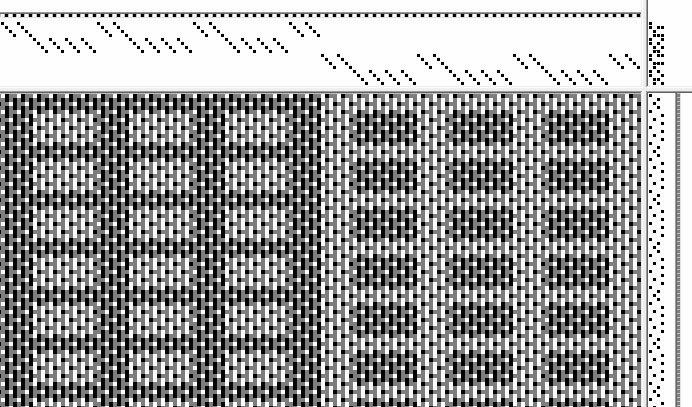
When I got started with this idea, I was playing around with profile drafts and quickly realized that in this design the front and back of the fabric were very different. In this screen shot the front is on the left, and the back on the right:

When you move through the color blocks for each row of circles the neutrals of the warp appear as circles embedded in the weft stripes. On the back the opposite is the case, the vertical stripes of the warp have circles of color embeded within. Magic!

Here is the Profile Draft for the design. You can go crazy with different structures, but personally, I think the Diversified Plain Weave that I used for this scarf is the way to go.

Enjoy!


Shameless Plug

(This blog post was originally published February 26, 2013 on my first blog site, which is no longer in existence.)

I’ve been weaving a lot of circles (see my previous post) and using a lot of colors of rayon chenille in small quantities. And it occurred to me, this isn’t a problem, for me, because I dye my yarn. I even over-dye my yarn if I don’t like the current color. But for many weavers, having a lot of colors of rayon chenille at your finger tips might be a pretty expensive proposition.

You can order chenille from the big yarn suppliers, but only on 1 pound cones. At upwards of $15-$20 per cone. Ouch. This is where my shameless plug comes in. I have a shop on Etsy where I sell hand-dyed and hand-painted rayon chenille, in addition to hand-painted tencel and cotton yarns. In small quantities. I sell the cotton and tencel in 4 ounce skeins. And I sell the rayon chenille in 4 ounce skeins. I could even dye to order if a request came my way.

I’m not the only indie dyer out there selling, but if you think about it, this is a real convenience that we provide. Folks needing small quantities should really look into this as a yarn source.

Ok. As I said, I’ve been weaving circles

Circles in Diversified Plain Weave. The warp is alternating stripes of black and gray rayon chenille. The weft is (you guessed it) stripes of rayon chenille in bright colors. This is the prototype scarf for a project I’m hoping will land in a forthcoming issue of a weaving magazine. More about that later.

After I finished weaving my scarves I decided to push the circles idea further and came up with this:

This profile draft has 8 threading blocks, which means for a weave like Diversified Plain Weave or Summer and Winter, you will need 10 harnesses. It will weave in Crackle on 8 harnesses, but I like DPW or S&W better. This design will just have to wait ’til I have more time to devote to it.

Pretty cool huh?


Going Around in Circles

(This blog post was originally published January 4, 2013 on my first blog site, which is no longer in existence.)

And, here we go with the new year. I don’t have resolutions per se, just a list of modest goals. I have some time off between semesters and I am home for two more weeks, so theoretically, I should get some stuff done.

For instance, go through the kitchen cabinets, remove items that haven’t been used in, like, years, and take them to the Goodwill.

Sew a couple of pillows for the couch, which could really use a little bit of freshening up. It should be easy. I’ve had the fabric for about five years as long as we’ve had the couch. Just need to buy some trim and pillow forms. Easy!

On the fiber front, I’m knitting a sweater and 99% done. Knitting a second sock, always a challenge, but it works well with the bowl games in the evening.

Painting more yarn for my Etsy shop. Watch for Pashmina Purples and Winter Blues! Further, I added several of my handwoven scarves to the Etsy shop. They were just sitting around, and needed to make themselves useful.

And speaking of weaving, I am in design mode. A little background: I’ve been seeing some lovely examples of scarves with a circles motif on Weavolution and also on the Handwoven Flickr group. I was kind of obsessed with figuring out a profile draft for circles for my own work after seeing these. I have an 8-shaft loom, so any block weave is going to be limited to six at the most.

At the same time, I got hold of a copy of Alice Schlein’s The Liftplan Connection. I decided the best way to figure this profile draft out was to use PhotoShop Elements, and Schlein’s book is the go-to manual for doing just that. Even better, she included a circle motif as one of her examples. So, using her directions in Elements I copied the cirlce motif, imported it into my weaving software, which in turn generated a draft.

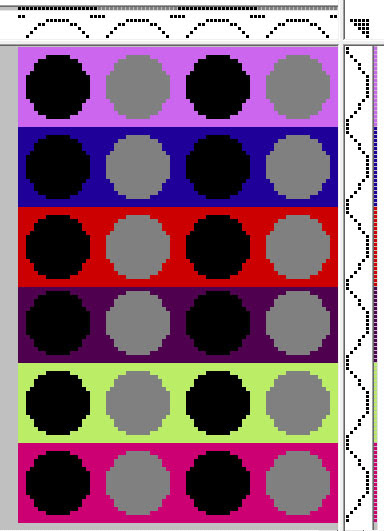
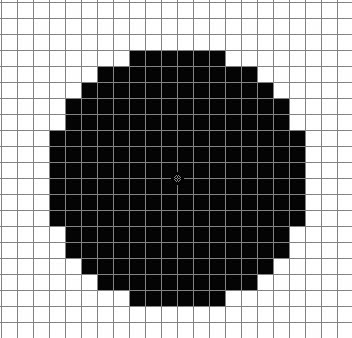
This is the design I used:

Ok, I know it’s not a perfect circle, and if I had more harnesses to work with it would be much smoother. However, I have just five blocks to work with for the circle itself, plus one block for the background, so that’s as good as it gets. I have an idea for a Diversified Plain Weave Scarf, and I need to paint some yarn in order to get that on the loom.

I’m pumped.


Whipping Up a Fresh Batch of Dish Towels

This is a quick shot of the first of my new batch of dish towels on the loom. I'm using my tried and true Turned Taquete technique, but as usual I didn't think it through.

I had planned for a checkerboard effect with the taupe/gray background and multicolor checks. I warped the gray areas in the solid color with no contrast. And I had hoped to isolate the color squares with gray all around. But. To do that, I needed to alternate gray/color/gray/color. Instead, I alternated color/color.

This makes for a nice variety of colors overall, but my intended result is not happening.

I am getting better at using my new warping reel, though. So that's a good thing. And the winding on went smoother for a change.

My next idea is to use this technique for placemats. I will probably order 5/2 cotton for the warp and sett it pretty close at about 24 epi I think. And maybe use 10/2 cotton for the weft. We'll see.

Turned Taquete, the Saga Continues

(This blog post was originally published March 17, 2014 on my first blog site, which is no longer in existence.)

So I’ve been moving quite slowly in the weaving department. A lot of life changes are happening Chez Iowaweaver. The husband retired at the end of 2013. My own retirement looms (ha! a pun!) at the end of June. Our house is our very own episode of Hoarders as my husband seeks to consolidate his office papers and books and regain a semblance of order and sanity.

The next episode of Turned Taquete was themed in greens and blues and I put on a warp for four towels using the threading draft I blogged about last time. See draft below. I had enough colors and ideas for treadling orders that I didn’t get bored, and the weaving actually went pretty fast.

Here are a couple of photos of the towels while still on the loom:

This is the weave draft. I sett 10/2 cotton 30 ends per inch. The warp was 20″ wide and I had five 4″ sections, so just imagine another section on the left to match the section on the right. ๐Ÿ˜‰

Here is the towels’ group portrait:

And individual shots:

In other news, I’ve been dyeing sock yarn and other knitting yarn with fiber reactive dyes in the crockpot. This is a process that I got to know about three years ago, but didn’t pursue. But I like it lot! It is super easy. And I am going to continue with it more seriously, especially since I will have more time when I am retired. So, guess what I’ll be blogging about next time?


OK, I Think I’ve Got It

(This blog post was originally published November 22, 2013 on my first blog site, which is no longer in existence.)

When I started thinking about Turned Taquete on 8 harnesses last summer I came up with a simple profile draft in a positive/negative window pane design. My weaving software has a block subsitution feature which transforms a profile draft to the structure of your choosing. I picked Turned Taquete and this 16-harness weave draft was the result:

Ok, it was the look I wanted, but not the number of harnesses.

Not to be deterred, but clearly not working on it full time, I thought about this issue occasionally. Gradually, it dawned on me that I could work around my limitations. I wouldn’t have exactly the same weave draft, but I could come close.

First I considered the color drafts in both threading and treadling. Look closely and you’ll see that in the threading black and white alternate, while in the treadling only one color is used, a mid-tone neutral gray. There are areas of solid vertical stripes and areas of rectangular blocks. I decided to change out the black/white alternating areas in the threading, where we see the solid stripes, with solid, non-alternating areas of color, while keeping the black/white alternation in areas of rectangular blocks. In addition, I used the same neutral gray in the treadling color draft.

This is the result:

I think I’ve got it!

Ok, not exactly the same draft, but pretty darn close. I could get closer by repeating the sections on harnesses 1-4 and 5-8 two or three times, but I kind of like this as it is.

A bit later, I decided to see what the draft looked like by using black and white in the treadling draft. Here we have black/white/black/white/black:

Here we have white/black/white/black/white:

I like that by using solid areas and alternating areas of color in the threading you can see six different areas of color and structure in the weave!

Coooool!


The Scientific Method – 8 Shaft Turned Taquete

(This blog post was originally published November 2, 2013 on my first blog site, which is no longer in existence.)

Hypothesis: In weaving it is generally the case that 8 harnesses will yield a more complex cloth than 4 harnesses.

Experiment: Weave some Turned Taquete tea towels using an 8 harnesses threading.

Results: Not so much. Here’s the deal. The towels that I wove on 8 harnesses could just as well have been woven on 4.

Turned weaves are a trade-off. You turn a weave, often, for the convenience of being able to weave a complex weave structure which, unturned, would require two shuttles. Turning, you weave the cloth with one shuttle and speed up the process.

Here’s my basic weave draft:

Ok, basic in that I didn’t really use the threading. What I did use here was the tie-up and the treadling. Yup, I only used four treadles and the only difference between Block A and Block B was alternating the tabby treadles (1 and 2).

I used two threading blocks. Block A was threaded using harnesses 1-4, and Block B was threaded using harnesses 5-8. Each block was four inches wide and I used Block A three times and Block B twice. The towels were 20″ wide in the reed.

One tactical error was in the colors I chose and how I used them. You really need high contrast colors for Turned Taquete to work well, and I had gone crazy buying new 10/2 cotton, but the colors I went with, though nice and pretty enough, didn’t have the contrast I needed.

But, I love, love, loved weaving the towels. It was so much fun deciding what the next sequence would be. The texture is wonderful. Still, I could have done them with four harnesses. What do you think? There is so lttle published on Turned Taquete, and maybe I could have figured out a different tie-up or something, but maybe not.

Here is one of the towels posing for its portrait:

And a detail:

If I had threaded this weave on 8 harnesses using a standard summer and winter structure (which is what Turned Taquete basically is) and woven it with one shuttle, would I have ended up with towels that matched my original vision? What the heck, I have tons more 10/2 cotton…


Turned Taquete Tea Towels — Terrific!

(This blog post was originally published November 13, 2012 on my first blog site, which is no longer in existence.)

The final results are in. The Turned Taquete Tea Towels are finally done, off the loom, washed, hemmed, and ready for their close-up.

Wow! If I do say so myself. The color combinations are fabulous, the structure is never boring. I think this is the beginning of a beautiful friendship.

To recap: I used 10/2 cotton for both warp and weft, sett 30 ends per inch. The warp was 20″ wide, and (ahem) not nearly long enough. I wove the first towel 30″ (under tension) plus an additional 1 1/2″ on each end for hems. The second towel was not nearly as lucky. I was only able to weave 23″ plus hem allowances on that one. (When will I learn?) So the second towel is really a Tea Square. A new genre. I just made it up.

Off-loom, the measurements were 28 1/8″ x 19″ and 21 1/4″ x 19″ respectively. I hand washed the towels for their first laundering. The colors barely ran at all, so I probably could have put them in the washing machine with a regular cold wash load with no worries. Air dried, and steam pressed while still damp.

Finished measurements are 26 3/4″ x 19″ and 20 1/4″ x 19″ respectively. So, I calculate about 11% shrinkage in length and negligible shrinkage in width. I used mini-cones of 10/2 cotton from Halcyon yarn that I bought in the mid-90’s. This yarn has been more than patient, wouldn’t you say? I’ve only got a few colors left now, and I looked online to see if it’s still available, and it is. And at the best prices you are going to find for mini-cones anywhere! I see more 10/2 cotton in my future….

So, here’s one more picture for the road:


Turned Taquete Tea Towels

(This blog post was originally published October 30, 2012 on my first blog site, which is no longer in existence.)

Like the alliteration? This blog is practically going to write itself. And the tea towels? They’re practically weaving themselves. Really, this Turned Taquete technique is a real blast. [For the record, turning a weave structure basically means taking a two-shuttle weave and making it a one-shuttle weave. The warp will alternate colors (dark/light) or thickness (thick/thin), and the weft will be one color or thickness and on one shuttle.]

Taquete used to be called Summer and Winter until somewhere in the 90’s (yes kiddies, it’s true) when the weaving magazines suddenly decided the correct term was Taquete (there is supposed to be an accent on the last “e”, but it’s too much trouble to figure out how to do it, so just pretend it’s there ๐Ÿ™‚ . And, by extension, Turned Taquete is the same structure as Turned Summer and Winter.

I worked up a sample weave draft in WIF ‘n Proof. Rather than an exact drawdown, this is a visual of the color and structure, from which endless variations could be teased. The threading is just a four harness straight draw. Easy peasy, right? Colors alternate on even and odd harnesses, and then switch to odd and even, creating blocks when woven.

Here is the Treadling sequence and Tie-up. One shuttle is used in the weaving and this is where the “turned” part comes into play. The treadling sequence,


1323, 1323 or 1424, 1424


is the sequence that would normally be used in the threading of (not turned) Taquete. I changed colors when I changed blocks, and sometimes I didn’t change blocks, I just changed colors. It was all pretty much stream of consciousness weaving. On the reverse side, the color blocks will be the opposite of front side.

Here is a Fabric view of the above threading and treadling:

And here is a complete draft with a detail of the actual fabric superimposed below (I love digital everything):


The weaving of these towels has gone super fast. Changing colors produces a mix in each block, multiplying visual interest seemingly infinitely.

Here is another shot of the loom:

I am using a temple to weave the towels, and I love that the color goes with the weaving project.

The warp is 10/2 cotton, sett 30 epi. The width in the reed is 20″ and I’m weaving each towel 30″ plus extra for hems. I’ve got one done, and one to go. Next project I’m going to make an eight harness draft, and see what I can do about combining blocks in the design.


My Left Pinkie

(This blog post was originally published September 11, 2012 on my first blog site, which is no longer in existence.)

The weaving projects chez moi have been far between. The last one, the diversified plain weave version of a crackle design, came off the loom in June. I was all set to do something completely different.

In early summer I was reading Weaving Today, and it seems the Handwoven folks had just put together an e-book compilation of projects using 10/2 cotton. I thought, just the ticket! I have a bunch of mini-cones of 10/2 cotton that I acquired in the, uh, mid-90’s. (They don’t go bad. Really.) So I bought it and downloaded it to my iPad. I liked the Turned Taquete Tea Towels project and I’ve seen other towels in the same technique, so I went ahead and wound a warp for a couple towels. Starting small.

But. The warp was going to be 20″ wide, and my inclination was to go ahead and order a temple to keep the weaving at an even width while weaving. I remember struggling with drawing-in cotton warps in years gone by, and really didn’t want to deal with those kind of problems any more. So I did order the temple, which is a whole other saga, and took a month+ to be delivered in one piece and in a box that didn’t fly open in transit. (They know who they are.)

Turned Taquete Warp

So now it’s the end of July, and HOT. My sister is visiting, and we are suffering in 100+ heat. My studio is the sun room, on the south side of the house, and with no air conditioning. ‘Nuff said. No loom work going on then.

In mid-August the husband and I traveled to California for 12 days. On Day 5 I stumbled on stairs, going down to use the bathroom, and whacked my left hand on the bannister. I was so sleepy that I didn’t notice pain until I was sitting down and, you know…

I thought my pinkie was sprained. Really. It swelled, bruised up, but wasn’t really immobilizing. I could still function and attend fun vacation-type events. When I got back home, I scheduled a doctor visit as soon as I could, and got it x-rayed. Yup.

Fractured.

Turned Taquete Warp and Pinkie

So what you see here is the total progress I’ve made threading this warp through the reed. I have threaded 3 bouts out of 5. Each bout has 120 threads and the grand total is 600. Hovering in blurry close-up is my hand, with my pinkie and 4th finger splinted together. I am in the 3rd week of 4 weeks of splinting. It’s anybody’s guess what will happen after that. I hope, fervently, that I can take it off for good and get some hand therapy for a while.

And don’t get me started about how much golf I’m missing.